
Alerted See & Avoid
In the modern age of electronic flight bags (EFBs), GPS, TCAS, and other electronic devices, pilots are more distracted inside the cockpit than ever before! Combine this with inconsistent radio communications, increased traffic density, and more frequent RPT traffic in regional areas, and the holes in the swiss cheese start to align!
Near miss and loss of separation events are one of most common occurrence types reported to RAAus. Now, more than ever, it is important that pilots maintain regular and consistent radio calls and look out techniques in order to maintain situational awareness.
Pilots must avoid the temptation to become dependent on position information displayed on EFB or TCAS displays – This technology relies on the fitment of similar equipment in other aircraft, often resulting in inconsistent traffic displays and the potential for traffic to go unnoticed. Whilst this technology is valuable in assisting situational awareness, it must not replace the requirement for pilots to maintain a constant lookout and the need for regular radio calls for efficient alerted see and avoid principles.
Head of Training Development, Neil Schaefer, recently observed the importance a maintaining a visual scan when conducting a flight review with an RAAus pilot. The pilot, who was using a SkyEcho ADS-B receiver, showed signs of complacency by relying on traffic information displayed on their iPad. During the flight review Neil visually spotted two aircraft in the local area which were not identified by the pilot in command – Neither aircraft was displayed on the pilots EFB.
View our 2021 National Safety Month presentation on Safety at CTAFs
Do you know your radio requirements?
CAR 166C requires pilots of aircraft carrying a serviceable radio which they are qualified to use, to make a broadcast whenever it is reasonably necessary to do so to avoid a collision, or the risk of a collision, with another aircraft at a non-controlled aerodrome.
Radio carriage is mandatory for aircraft operating at or within the vicinity of a registered or certified aerodrome and for aircraft operating above 5000ft AMSL in class G airspace.
Remember, ‘in the vicinity’ is within 10 nm, and at a height where your operations could be in the way of other traffic.
When operating outside the vicinity of an aerodrome, pilots should monitor the appropriate Area VHF frequency.
Radio broadcasts must include:
(a) the name of the aerodrome;
(b) the aircraft’s type and call sign;
(c) the position of the aircraft and the pilot’s intentions.
The following table provides recommended broadcasts in the vicinity of non-controlled aerodromes:
(Image source: https://www.atsb.gov.au/media/5779431/figure-4.png)
Do you know your transponder requirements?
AIP GEN 6.1 outlines the requirements for pilots’ operating transponders under VMC in the various classes of airspace.
Aircraft instruments, including airspeed indicators, altimeters and transponders must be calibrated every 2 years in accordance with the RAAus technical manual. Aircraft operating within controlled airspace must have their instruments calibrated in acordance with CAO 100.5
It is important to note that there are no permitted unserviceabilities for transponder equipment without the express written permission from CASA. If your aircraft is fitted with a transponder it must be fully serviceable, configured and operating during all flights, even in airspace where a transponder is not required.
The Standard transponder codes that RAAus pilots should be familiar with are outlined in AIP as well as the Visual Flight Rules Guide and should be transmitted as soon as entering an active runway and in flight until the flight is terminated. Operations during taxi or other ground movements should not transmit Mode S or C (ALT) function to avoid possible traffic proximity alerts with any nearby aircraft, particularly where RPT operations occur.
The most common codes RAAus pilots should know are:
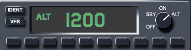
1200 -Civil VFR flights in Class E or G airspace
3000 – Civil flights in A, C and D airspace, or IFR flights in Class E airspace
7600 – Communications failure
7700 – Emergency
Do you know how to conduct a thorough visual scan?
Do you know how to conduct a thorough visual scan?
During our training we are taught that during VFR flight our eyes should remain outside the cockpit 80% of the time, however in a changing world full of additional avionics, GPS devices and electronic flight bags (EFBs), we have an increased number of distractions tempting pilots to turn their eyes inside the cockpit!
Despite improvements in radios, GPS and traffic information, it is still just as important, if not more important, that we fight the urge to play on our ipads, and turn our eyes outwards. Of course our ability to identify other aircraft is only as strong as our scanning technique.
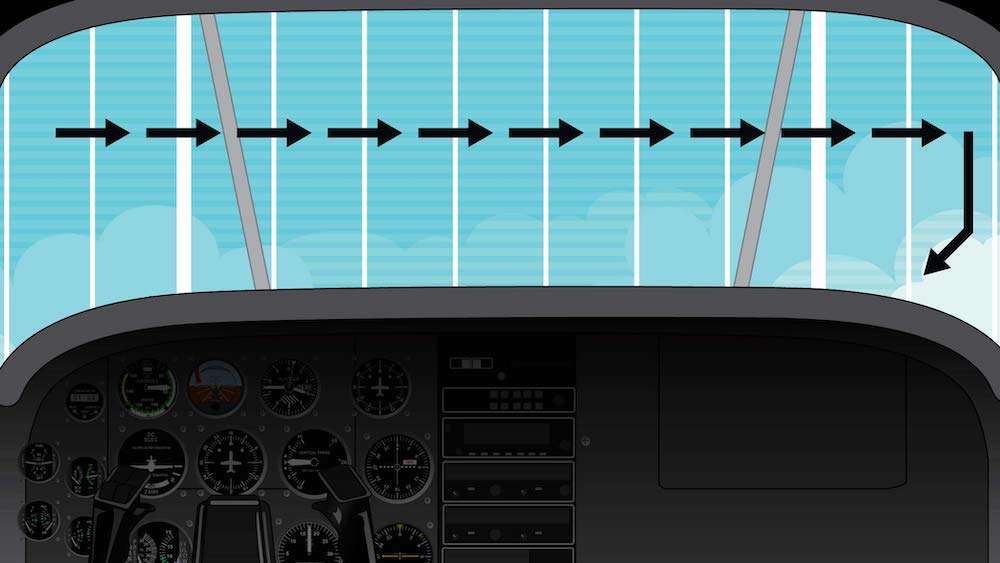
The human eye requires 1-2 seconds once stationary in order to focus. When conducting a visual scan of the horizon the eyes are unable to focus if one continuous sweep is made. It is therefore important that pilots divide the sky up into 10 to 15 degree blocks, stopping to allow the eyes to focus within each block.
Once the eyes have focused in a particular area, pausing for a moment will allow the eyes to detect movement from other aircraft. Peripheral vision is particularly good at detecting motion as you scan across the horizon.
Always remember to conduct a thorough scan prior to turning finishing your scan in the direction of the turn!
(Image source: https://www.aopa.org/training-and-safety/online-learning/safety-spotlights/collision-avoidance/the-scan)
Check, Confirm, Communicate - Steps for efficient communication!
Simple steps to ensure you communicate effectively in your flight operations.
Effective communication in visual flight operations is critical to safe operations and is a skill all pilots need to understand and apply in their flying activities. Regardless of the class of airspace you are operating in, the following common elements are essential for safe and compliant operations.
Check
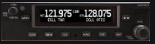
- Your radio serviceability. This means confirming receiving and transmitting capability wherever possible using the radio selectors and alert lights, AWIS and other automated aids, other pilots or ATC services. (CAR 242). Don’t forget to check your headset is working correctly too!
- Your system knowledge. Know how to correctly use the radio or transponder and associated avionics, whether it’s a simple radio, part of a stack or integrated into associated navigation systems. (Type training – section 2.01 of the Operations Manual and RAAP 1). Don’t forget you need a radio endorsement to use the radio.
- Your frequencies. Know the correct frequencies for both your local operations, route sectors, Area requirements, weather and other information frequencies.
- The radio requirements for your intended operation whether CTAF, local procedures, Mandatory zones, Restricted, Controlled or NOTAM requirements.
- Your equipment compliance. If it’s fitted it must be calibrated, operational and turned on including setting transponders to ALT.
- Visually for other aircraft by regularly conducting a thorough scan. VFR pilots should have their eyes outside of the cockpit 80% of the time.
Confirm
- You’re on the right frequency
- Your transmissions are legible
- You pause and compose correct phraseology before transmitting
- Where you are – know radially in distance and height where you are from a known reference or location in which you are broadcasting.
- See and avoid and “Alerted” See and Avoid” is your responsibility (CAR 163)
- Location of other aircraft if you believe another aircraft may be operating in the area or are unable to identify the location of another aircraft following receipt of a radio call
Communicate
- Actively listen to build a situational picture
- Think before you transmit
- Make regular radio calls through broadcasts on the appropriate frequency
- Say it once- say it clearly.
- If in doubt- Ask or say again
- Use standard phraseology.
Be Heard, Be Seen, Be Safe!
CASA has a valuable resource for pilots relating to radio procedures in non-controlled airspace.
CLICK HERE TO VIEW